Year 1
Someone cried at the second meeting. You canceled a board call to make the retreat. You drove home buzzing, half-terrified by how honest it got. The room was building something, and everyone could feel it.
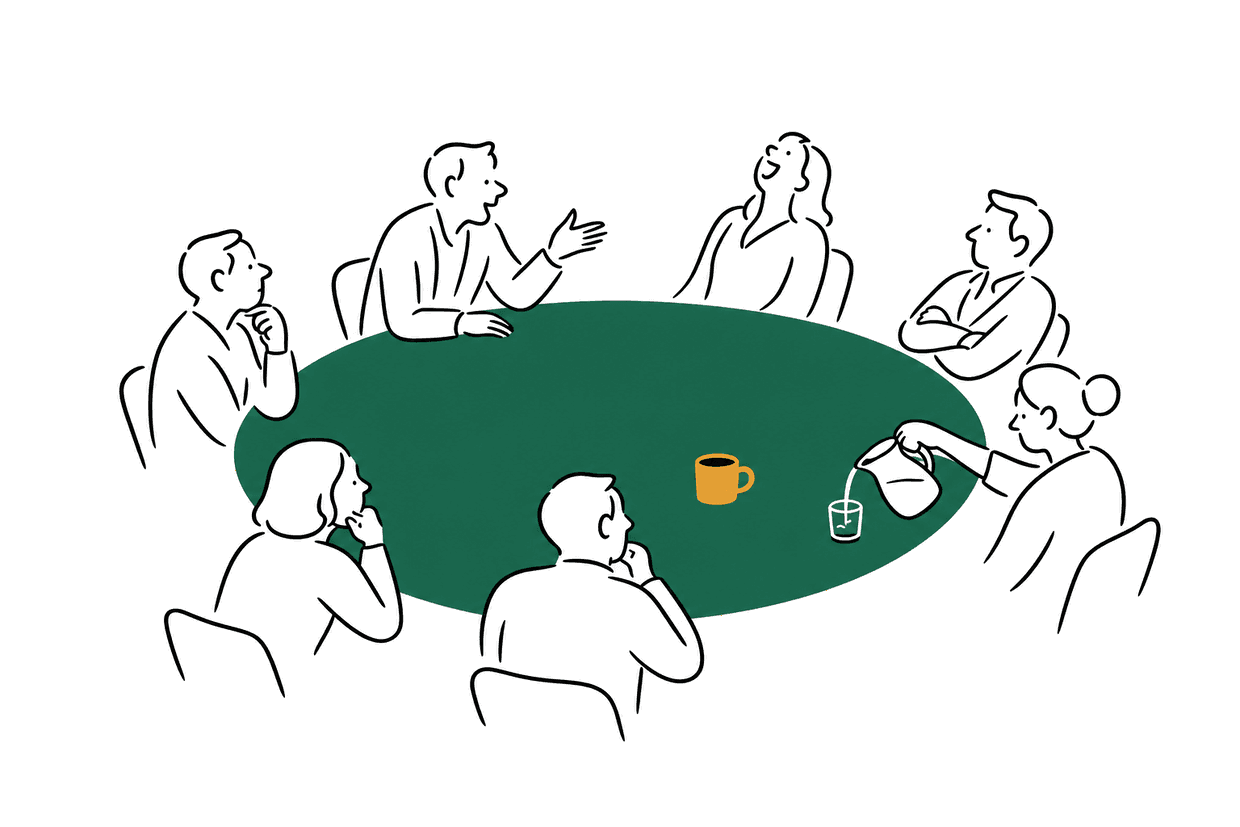
A yearly reset for your forum
Once a year, every member reviews every member. Feedback is reworded so it’s anonymized, constructive, and actionable. Each of you gets a personal report on your strengths, weaknesses, and opportunities to grow — and the forum gets a scorecard on itself.

Andrew Wilkinson
Co-founder, Tiny
Forum member since 2009.
“I’ve been in forums since 2009 and they have changed my life in so many ways.Some of my forum members know me better than my closest friends, but so much goes unspoken.People don’t realize they are stuck in loops. Or how they come across to the group. Or even just all the positive things that everyone feels about them.Doing 360s for my own forum groups has been transformational, and helped all of us grow, get unstuck, and ensure the forum stays healthy.”
In EO and YPO, that’s a forum: the same people, meeting every month, in confidence, for years. They talk about the real stuff — the business, the marriage, the thing they can’t say to the board. That’s the room this is for.
Year 1
Someone cried at the second meeting. You canceled a board call to make the retreat. You drove home buzzing, half-terrified by how honest it got. The room was building something, and everyone could feel it.
Year 5
The trust is real. The friendships are real. And the feedback has quietly gone comfortable. Updates run a little long, the same two people do most of the reaching-out, and nobody’s failing. The room just stopped getting sharper, and no one has a way to tell.
Attendance tells you people show up, not whether the feedback lands or trust is climbing. This can.
Composites, for illustration. Yours are built from your own forum’s answers, with giver names removed and comments reworded before they appear.
What someone typed
Honestly Dave, you always make every update about the Series B and it’s exhausting.
What the report says
“Your updates are always the wins. We’d back you a lot harder if we heard the part you’ve been carrying alone.”
“You’re the reason this forum feels safe — and the first to reach for a joke when it stops feeling that way. The group has learned to let you.”
Paste your members’ emails, pick a window, hit start; everyone signs in with a magic link, no passwords. Forum 360 sends every invite, then a short daily reminder to anyone who hasn’t finished, until the deadline.
Each member rates and writes about every other member across eight dimensions, rates themselves on the same eight, and answers a short set of questions about the forum itself. About 30 minutes per person you review, once a year.
AI rewords every comment and screens it for identifying detail, then combines it across at least three reviewers, so what surfaces is the pattern, not a named source.
It lands in one inbox.
Every report goes to the person it’s about, and nobody else. You read yours alone, first.
You get to sit with it.
It reads like a sharp friend, not a verdict: scores are context for the words, and there’s no ranking against anyone else.
The forum works through it together.
The shared forum-health report comes with a ready-to-run agenda for the meeting where the forum talks about itself, so the hard conversation has rails.
Most “anonymous” surveys are anonymous the way an unlocked diary is private. Here is what Forum 360 does instead:
Every comment gets reworded before anyone sees it. What lands in a report is the point, never the person.
When a reworded version is stored successfully, the raw text for that answer is cleared in the same database update. If processing fails, the raw item is held out of that report run and retained only so it can be retried.
If fewer than 3 members review someone, that report is never created, and a category enters a report only after 3 members contributed to it. Names and raw wording never appear, though a distinctive fact may still be recognizable to people who know you well.
Whoever runs the cycle can see who has finished and who needs a reminder, plus sanitized aggregates after release — never raw or per-giver feedback. A chair who takes part receives the same private report as every other member.
Every member gets a report that reads like a sharp friend who’s been in the room for years.
A forum that’s met for ten years remembers itself in inside jokes and a couple of legendary meetings. Forum 360 gives it a memory with numbers. The first cycle is a snapshot. Every cycle after that is the room watching itself get better.
The year you can point to the line and say:we’re making each other better.
One annual cycle for up to 12 members, self-serve from start to report. No seats, no tiers, and nobody will ever email you to “hop on a call.”
$499
per forum, per year · tax extra
You spent more on wine at the last retreat.
If too few members finish for anonymous reports, we refund the $499.
Add your members first. You pay $499 only when you send invites — nothing before. Billed annually, plus applicable tax calculated from your billing address, and renews automatically until canceled. One complete review each year. Your history always stays.
No. The chair sees who has finished and, after release, the shared scorecard and each member’s aggregated scores. No screen shows the chair what a person wrote. The details for your CTO are on the Security page.
Forum 360 removes giver names, rewords submitted comments, shows ratings only in aggregate, and suppresses a personal report if fewer than 3 people review someone. Those controls reduce attribution risk; they cannot make a distinctive fact or long-held viewpoint unrecognizable to people who already know the room. The product does not promise perfect anonymity against human inference.
It happens — and usually it’s the member the forum most wants to hear from. Three things help. The ask is about 30 minutes per person you review, once a year, while everyone else is doing it. Fewer voices mean thinner reports for the people they care about, so opting out is visible. And the anonymity protects them exactly as much as everyone else. Put the deadline on a meeting agenda; that is the single best nudge. And honestly: a member who won’t spend about 30 minutes per person you review, once a year, isn’t a data problem. That’s a finding.
If too few members finish for anonymous reports, we refund the $499. That is the completion refund: the same $499 back only if every personal report is suppressed because participation is too thin. It does not change the price or pay-at-send. It is not a 30-day money-back guarantee, and it is not a partial refund.
It didn’t blow up the founder’s forum, and the design pushes the other way. Nothing arrives raw. Every comment is reworded, combined across reviewers, and delivered privately, so nobody’s ambushed in front of the group. But the real question deserves a straight answer: if a forum can’t handle honest feedback delivered kindly and anonymously, it already has a problem, one that’s compounding quietly instead of getting handled.
You brought in the instrument. You are not the messenger. Nothing arrives in your voice. Reports land privately first. The follow-up meeting has rails: the group scorecard, a ready agenda, and a script for when to say less.
You can run a free survey. Here’s what happens: everyone knows the moderator can open the raw responses, so everyone writes the version of the truth they’d be comfortable being caught with. Writing style is a fingerprint — these people have read your emails for a decade. And then someone has to turn fifty-odd raw reviews into a personal report for every member, plus the forum scorecard, without leaking who said what. The thing you’re paying for is the machine that makes honesty safe, and the writing that makes it land.
No. A forum-health survey is a checkup on the room. EO recommends one before a retreat; YPO Brasil’s legacy guide describes aggregate survey results. Confirm current pricing, eligibility, and YPO Connect access with your organization. Forum 360 is a different job: every member reviews every member. Comments are reworded and combined across at least three reviewers before feedback appears. Each person gets a private report; the group gets a scorecard. The chair sees checkmarks, not answers. Use a health survey to check up on the forum. Use this if you want each person to hear what the room has been holding back.
If a consistent group of peers meets on a rhythm and talks about real things (a YPO or EO forum, a self-run group, a mastermind, a partners’ meeting that became something more), it fits. A typical room is 6–10 members — about seven people — who’ve watched each other operate. The hard cap is 12. That’s the whole requirement.
The great one that wants to stay great: deep trust, real friendships. Give it an instrument so it keeps getting sharper instead of coasting on chemistry. The self-run forum: no HQ, no trained moderator, no tools. This is the structure you’ve been improvising, run for you. And the one that wants proof it’s working: you feel like the room is good, and this turns the feeling into a number you can point to, year over year.